

FRANKFORT, KY (Nov. 19, 2026) – Kentucky health officials are continuing to respond to the largest measles outbreak in the state in over 30 years. More than 200 cases have been confirmed in 16 counties across the state this year. All but two cases in 2026 have been in people who were not vaccinated against measles or whose vaccination status was unknown. Earlier this week, international public health officials announced that the U.S. has lost its measles elimination status, ending more than two decades of public health success in stamping out a highly infectious, potentially life-threatening disease.
“Losing our measles elimination status is a disheartening – and entirely avoidable – tragedy for American public health,” said Kentucky Cabinet for Health and Family Services Secretary Dr. Steven Stack. “Misinformation being disseminated by people in positions of leadership and responsibility has contributed to this setback, and the public is paying the price. We have safe and effective tools to prevent measles and other serious infectious diseases. We should be encouraging their use, not creating fear and confusion.”
The best way to protect against measles is through the measles, mumps, and rubella (MMR) vaccine, which is safe, effective, and widely available at local health departments, doctor’s offices and pharmacies. Local health department locations and hours of operations can be found at this link.
The Kentucky Department for Public Health reports that between Aug. 1 and Nov. 16, nearly 3,500 MMR vaccinations were administered in the counties with reported measles cases, many of which were administered through the local health departments in those communities. Forty-four of those vaccines were administered through the local health departments in those communities.
“Measles during pregnancy can result in pregnancy loss, early labor and the baby being born with a low birth weight. The virus can also be transmitted to the newborn, and cause severe illness,” said Dr. Stack. “Pregnant women and young infants under six months of age are unable to be immunized, so protecting them from measles means those around them must be vaccinated.”
In Kentucky, most cases in the outbreak have been in close-knit, under-vaccinated communities in several counties. Seventeen people have been hospitalized. Eight cases have occurred among women who were pregnant at the time their illness began and two newborn infants developed congenital infections.
Public health officials continue to track cases and identify sources of exposure associated with the outbreak. Updated case counts are published by KDPH each weekday, with the exception of state holidays, on the state’s measles dashboard.
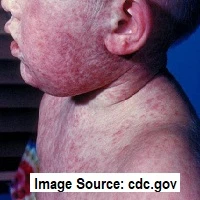
Measles, which is a highly contagious respiratory virus, can cause serious health complications, especially in young children. The disease is spread through the air, where it can remain suspended for up to two hours. Early symptoms of measles begin 8 to 12 days after exposure and include high fever, cough, runny nose, and red/watery eyes. The characteristic measles rash typically appears three to five days after symptoms begin, usually on the face before spreading down to the rest of the body.
The first dose of measles vaccine is routinely administered as part of the MMR vaccine that should be given to children at age 12 months through 15 months at the earliest opportunity. A second dose should be given at age four years through six years. Together, these two doses of MMR vaccine are 97% effective against measles according to the American Academy of Pediatrics and other experts. An additional early dose of MMR vaccine may be administered to babies 6 to 11 months of age who are at higher risk of being exposed to measles.
Some adults may need a second dose of MMR vaccine if they only received one previously or are uncertain of their vaccination status. This includes those traveling outside of the United States or those working in healthcare.
Immunization rates among Kentucky’s kindergartners have recently increased but are still below the national average. Results from the most recent school immunizations survey, for the 2025-2026 school year, indicate that only 90.7% of Kentucky kindergarteners are fully vaccinated against measles, which is lower than the national average of 92% in 2025-2026.
The U.S. has been experiencing a resurgence in measles cases in 2025-2026, with large outbreaks currently ongoing in several other states. As of Nov. 12, the CDC had reported 5,412 confirmed cases of measles across the country, the highest number of cases in a single year since 1991 and more than double the number of cases recorded in 2025.
For more information, visit Kentucky’s measles dashboard and follow KDPH on social media.